

by Dave The Kayaker
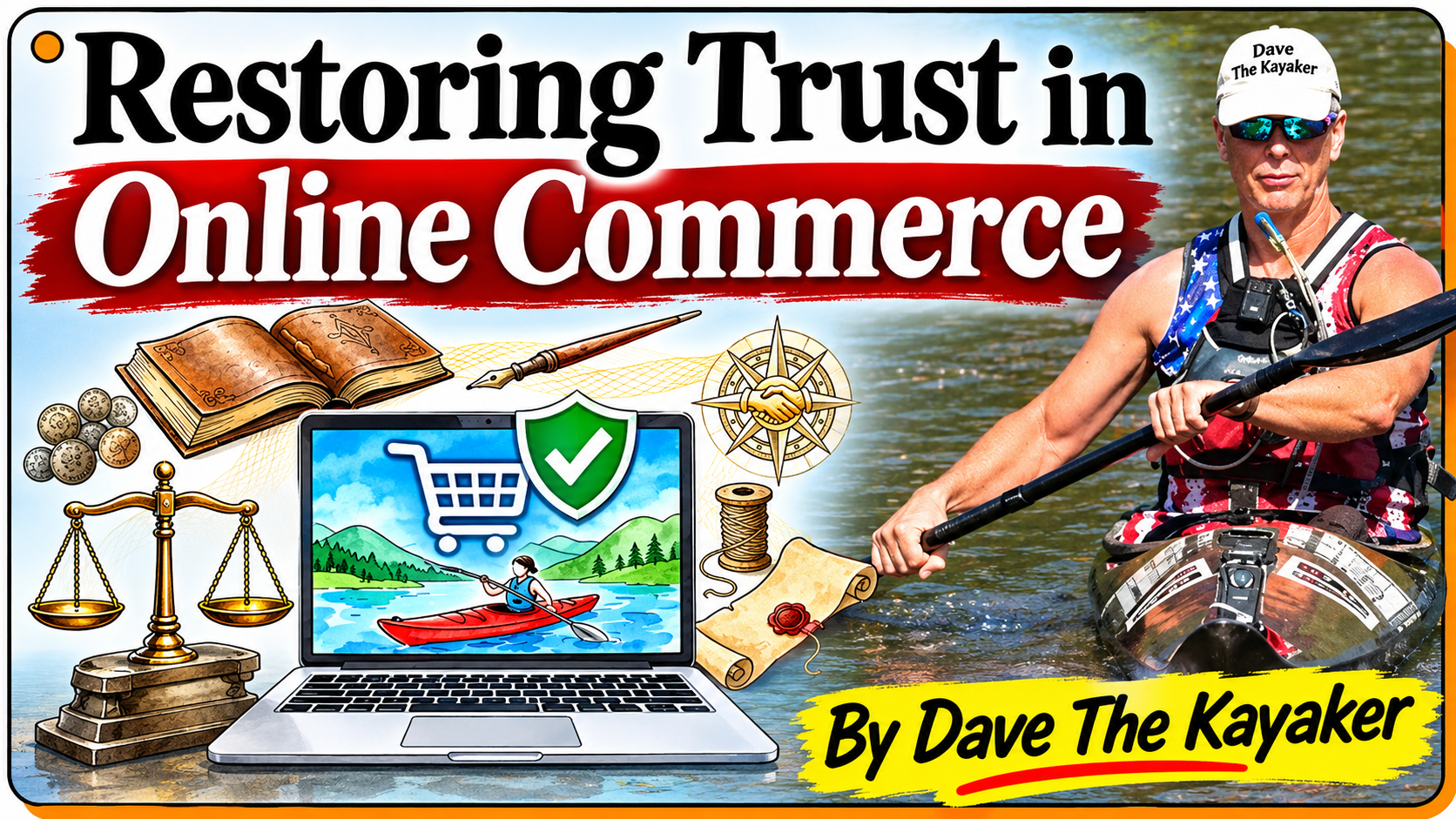
I’ve had a belly full of seeing used kayaks for sale online that are far too overpriced from sellers who either have no idea what they are selling by using phrases such as “oars included,” or it is so obvious they got something for free or a very low price and now are trying to sell it for an unreasonably high price.
Flippers and scammer are becoming more commonplace.
It’s Time for Americans to Stop Trying to Cheat Each Other
There is something deeply wrong with a society in which people have to approach almost every online interaction wondering whether the person on the other side is trying to cheat them.
Think about that for a moment.
You want to buy something online. Is the seller legitimate, or are they going to take your money and disappear?
You want to sell something you no longer need. Is the buyer actually interested, or are they going to send you a fake payment confirmation, invent some complicated shipping arrangement, or try to trick you into giving them personal information?
You receive an email from someone claiming to represent your bank. Is it legitimate, or is someone trying to steal your financial information?
You receive a message offering an incredible deal. Is it an opportunity, or is it another attempt to separate you from your hard-earned money?
You list something for sale on Facebook Marketplace, Craigslist, eBay, or another online platform. Instead of a straightforward transaction, you encounter people attempting to manipulate you, deceive you, or exploit your willingness to conduct an honest business transaction.
What happened to us?
When did buying and selling something become an exercise in suspicion? When did an ordinary person trying to make an honest transaction become a potential target for someone else’s dishonesty?
And perhaps the most important question is this: Why have we become so comfortable with the idea that it’s acceptable to scam one another?
Americans can and should do better. Let’s not normalize the scammy cultural practices of other countries.
The Normalization of Dishonesty
Online scamming has become more than a collection of isolated criminal activities. It has become part of a troubling culture in which dishonesty is sometimes treated as cleverness, manipulation is treated as business savvy, and taking advantage of another person is viewed as an opportunity rather than a moral failure.
Some people seem to believe that if they can trick someone into sending them money, they have accomplished something worthwhile.
Others deliberately misrepresent products, exaggerate their condition, invent stories, use deceptive photographs, or conceal important information because they believe that getting the money is more important than being honest.
There are people who advertise something they don’t actually possess. There are people who sell broken merchandise while claiming it works perfectly. There are people who create fake identities, impersonate legitimate businesses, and exploit the trust of strangers.
And then there are the individuals who make a business out of outright fraud. (Have you noticed the proliferation of AI-generated ads for health and fitness products that make impossible claims?)
The internet has made it easier for dishonest people to reach thousands, perhaps millions, of potential victims. A person no longer needs to walk into someone’s neighborhood to take advantage of them. They can sit behind a computer screen, create a fake identity, and attempt to deceive people across the country.
Technology has made commerce easier, but it has also made dishonesty easier.
However, technology isn’t the fundamental problem. The problem is the willingness of some people to use technology to exploit others.
We should never confuse the ability to get away with something with the right to do it.
The Victims Are Real People
One of the most disturbing aspects of online scamming is how casually some people dismiss its victims.
They say things like, “You should have known better.”
Or, “If you fall for that, it’s your own fault.”
Or perhaps, “That’s just how the internet works.”
No. That is not how the internet should work, and it certainly isn’t how a decent society should work.
The people who get scammed are not simply numbers on a spreadsheet. They are real people.
They are retirees living on fixed incomes. They are young adults trying to establish themselves financially and are merely looking for a good deal to save some money. They are parents trying to save money for their families. They are small-business owners trying to make a living. They are working Americans who have spent hours earning the money that someone else is trying to steal.
For some people, losing a few hundred dollars is an inconvenience. For others, it can mean missing a utility payment, falling behind on rent, or being unable to afford something essential.
And the damage isn’t always financial.
There is the embarrassment, the frustration, the loss of confidence, and the realization that someone deliberately manipulated your trust. That is why so many of these case (or crimes) go unreported. Victims are too embarrassed to admit they got scammed.
Perhaps the worst consequence is that victims become less willing to trust other people.
That is a terrible price for society to pay.
When enough people are victimized, everyone becomes suspicious. Honest sellers have difficulty finding buyers. Legitimate businesses have to overcome the distrust created by dishonest competitors. People become reluctant to help strangers because they fear being exploited.
Scammers don’t just steal money. They steal trust.
And trust is one of the most valuable things a society possesses.
The Internet Is Not an Excuse to Abandon Our Values
Some people behave as though the internet exists outside the normal rules of human decency.
They would never walk into a neighbor’s home and lie to them about the condition of something they were selling. They wouldn’t normally look a stranger in the eye and invent a story to steal $100.
But somehow, when they are behind a screen, they believe those same actions are acceptable.
Why?
Is it because they don’t see the person they are hurting? Is it because a computer screen creates emotional distance? Is it because they believe they are anonymous and therefore immune from accountability?
Whatever the explanation, none of it makes the behavior acceptable.
The person on the other side of that transaction is still a human being. They still have responsibilities, bills, families, and hopes for the future.
The fact that you cannot see someone does not make it acceptable to deceive them.
We need to bring basic human decency back into our online interactions.
If you advertise something for sale, describe it honestly.
If something is broken, say so.
If you promise to ship something, ship it.
If you agree to a price, honor the agreement.
If you receive payment for something, deliver what you promised.
If you make a mistake, acknowledge it and make it right.
These are not complicated principles. They are the foundations of ordinary, honest commerce.
The Marketplace Should Be A Marketplace, Not a Minefield
Online marketplaces have enormous potential.
They allow people to buy and sell used equipment, furniture, electronics, vehicles, sporting goods, clothing, collectibles, and thousands of other products.
They help small businesses reach customers. They give individuals an opportunity to earn extra money. They allow people to find products that might otherwise be unavailable in their communities.
There is nothing inherently wrong with making a profit.
In fact, making an honest profit because you are adding value is a perfectly legitimate and admirable activity.
The problem begins when making money becomes more important than being honest.
There is a tremendous difference between negotiating a good price and deliberately deceiving someone.
There is a difference between selling something for more than you paid for it and misrepresenting what you are selling.
There is a difference between being a good salesperson and being a dishonest one.
We should encourage competition, entrepreneurship, and free enterprise. But those things depend on a foundation of trust.
A healthy marketplace requires people who believe that agreements mean something.
If every transaction requires extensive investigation, verification, and suspicion, the marketplace becomes less useful for everyone.
Honest people should not have to spend their lives protecting themselves from dishonest people who have made deception their business model.
The Responsibility of Online Platforms
Technology companies and online marketplaces also have responsibilities.
Platforms that facilitate commerce should take meaningful steps to identify fraudulent accounts, remove repeat offenders, improve reporting systems, and protect legitimate users.
They should make it easier to report scams and harder for known scammers to simply create another account and continue their activities.
They should provide better education about common fraud techniques and make their transaction policies understandable.
When a platform profits from bringing buyers and sellers together, it has an interest in maintaining an environment where people feel reasonably safe conducting business.
No platform can eliminate every dishonest person. That would be unrealistic.
But platforms should not treat fraud as an unavoidable cost of doing business.
A marketplace that consistently allows dishonest individuals to exploit its users risks destroying the very trust that makes the marketplace valuable.
We should expect better.
The Role of Government and Law Enforcement
There is also a role for government.
Fraud is not merely bad manners. Many forms of scamming are criminal offenses, and the people who organize and profit from them should be held accountable.
Law enforcement agencies need the resources, training, and cooperation necessary to investigate online fraud.
Financial institutions, technology companies, consumer protection organizations, and law enforcement should work together to identify patterns of criminal activity and help prevent further victimization.
Americans should know where to report fraud. They should understand that reporting an incident can help identify repeat offenders and protect other potential victims.
The Federal Trade Commission provides a reporting resource at:
The FBI’s Internet Crime Complaint Center provides another resource:
Reporting a scam may not immediately recover someone’s money, but it can help authorities recognize patterns, investigate criminal operations, and warn others.
We should also be realistic. Some scams originate outside the United States, and international criminal organizations can be difficult to investigate and prosecute.
But difficulty is not an excuse for inaction.
We need better cooperation, stronger enforcement, and greater public awareness.
Stop Rewarding Dishonesty
Here is something every American can do immediately: Stop rewarding dishonesty.
Don’t knowingly buy stolen merchandise.
Don’t participate in fraudulent transactions because someone promises you an easy profit.
Don’t help someone deceive another person.
Don’t knowingly sell counterfeit products as authentic merchandise.
Don’t invent false reasons to demand refunds.
Don’t file fraudulent payment disputes.
Don’t misrepresent the condition of something you are selling.
Don’t use fake reviews to promote your business or destroy someone else’s reputation.
And don’t convince yourself that a little dishonesty is acceptable simply because you believe the other person can afford the loss.
Integrity is not something we should practice only when it benefits us.
It matters most when doing the right thing is inconvenient.
We should hold dishonest people accountable without becoming dishonest ourselves.
A Call to Action: Americans, Let’s Fight Back
I believe Americans are capable of something better.
We are a nation of people who work hard, build businesses, invent things, volunteer, help neighbors, raise families, and contribute to our communities.
We have a long tradition of self-reliance, personal responsibility, and looking out for one another.
Those values should not disappear when we log onto the internet.
So I am calling on ordinary Americans to take a stand.
Not with violence. Not with harassment. Not by taking revenge on people we suspect of wrongdoing.
But through personal responsibility, public awareness, honest commerce, and a collective refusal to accept fraud as normal.
Here is what I am asking:
1. Make honesty a personal commitment.
When you buy or sell something online, be the person you would want on the other side of the transaction. Tell the truth, honor your commitments, and treat people fairly.
2. Call out dishonest behavior.
When you encounter obvious fraud, report it to the platform and appropriate authorities. Share factual warnings with others. Do not remain silent simply because the scam didn’t affect you personally.
3. Support honest businesses and sellers.
Give your money to people who stand behind their products and promises. Reward integrity with repeat business and positive, truthful reviews.
4. Educate friends and family.
Talk to older relatives, young adults, and anyone who may be unfamiliar with online scams. Explain common warning signs. Teach people to verify payment notifications, avoid suspicious links, and never share passwords or verification codes with strangers.
5. Demand accountability from technology companies.
Tell online marketplaces that protecting users matters. Expect effective fraud reporting, meaningful enforcement, and better protection against repeat offenders.
6. Support effective law enforcement.
Report criminal activity, preserve evidence, and support efforts to investigate and prosecute organized fraud. Don’t assume that reporting is pointless.
7. Refuse to participate in the culture of cheating.
This may be the most important step of all. Don’t become the very thing you complain about. Don’t justify dishonesty because somebody else is doing it.
We cannot build a trustworthy society by participating in the behavior that destroys trust.
We Are Better Than That
I don’t believe the average American wakes up in the morning thinking about how to cheat another person.
Most people want to earn an honest living. They want to sell something and receive fair payment. They want to purchase something and receive what they paid for. They want to conduct business without being manipulated.
They want to believe that a person’s word still means something.
And that’s precisely why the culture of online scamming is so damaging.
It allows a relatively small but destructive group of dishonest individuals to make ordinary people question everyone else.
It creates an atmosphere in which suspicion replaces goodwill and deception replaces cooperation.
But we don’t have to accept that.
We can choose to be different.
We can choose to make honesty fashionable again.
We can choose to value our reputations more than a quick dollar.
We can choose to recognize that the person buying our used equipment, purchasing our old television, or responding to our online advertisement deserves the same honesty we expect from others.
And we can teach our children that success isn’t measured simply by how much money you accumulate. It is also measured by how you earn it and how you treat other people along the way.
There is nothing clever about manipulating a stranger into sending you money for something you never intended to deliver.
There is nothing entrepreneurial about building a business around lies.
And there is certainly nothing patriotic about making America a less trustworthy place to live and do business.
We should be proud of the things we create, the businesses we build, and the honest work we perform.
We should be proud when someone can say, “I bought something from that person, and everything was exactly as promised.”
We should be proud when a seller says, “That buyer treated me fairly, paid what we agreed upon, and made the transaction easy.”
Those are the experiences we should be creating.
Let’s Change the Culture
Imagine what the internet could become if more people approached it with honesty and goodwill.
Imagine being able to buy something without assuming the seller is lying.
Imagine being able to sell something without receiving a dozen suspicious messages from people attempting to manipulate the transaction.
Imagine an online marketplace where people build reputations through good service, fair prices, and honest descriptions.
Imagine a country where people are embarrassed to be caught cheating someone rather than proud of having gotten away with it.
That is not an unrealistic dream. It begins with individual decisions.
Every honest transaction helps. Every scam reported helps. Every person who refuses to participate in fraud helps.
And every person who stands up and says, “This isn’t acceptable,” helps change the culture.
We cannot eliminate every dishonest person. There will always be people who choose greed over integrity.
But we can make it much harder for dishonesty to flourish.
We can stop treating scams as normal. We can stop laughing about people getting ripped off. We can stop blaming victims for the deliberate wrongdoing of others.
Most importantly, we can stop participating in the problem.
America has plenty of challenges. We have economic pressures, political disagreements, social divisions, and plenty of things to argue about.
We don’t need to make things worse by turning on one another every time we conduct a transaction.
We should be helping each other succeed, not looking for opportunities to make someone else’s life more difficult.
We should be building businesses, not building schemes.
We should be earning money, not stealing it.
We should be creating value, not manufacturing deception.
And we should be restoring trust rather than destroying it.
My message to Americans is simple: Stop trying to scam each other. Stop trying to cheat each other. Stop treating dishonesty as an acceptable way to get ahead.
Be a better buyer. Be a better seller. Be a better business owner. Be a better neighbor. Be a better citizen.
Hold people accountable, demand better from online platforms, report fraud, and refuse to reward those who make a living deceiving others.
We don’t have to agree on everything to agree that stealing from one another is wrong.
We don’t have to share the same politics, religion, background, or economic circumstances to recognize that honesty matters.
We are all better off living in a society where people can trust one another.
Let’s bring some integrity back into American commerce and American life.
Let’s make honesty an expectation, not an exception.
Let’s make doing the right thing more important than making a quick buck.
America, we are better than this.
It’s time we started acting like it.
All the best,
Dave

