

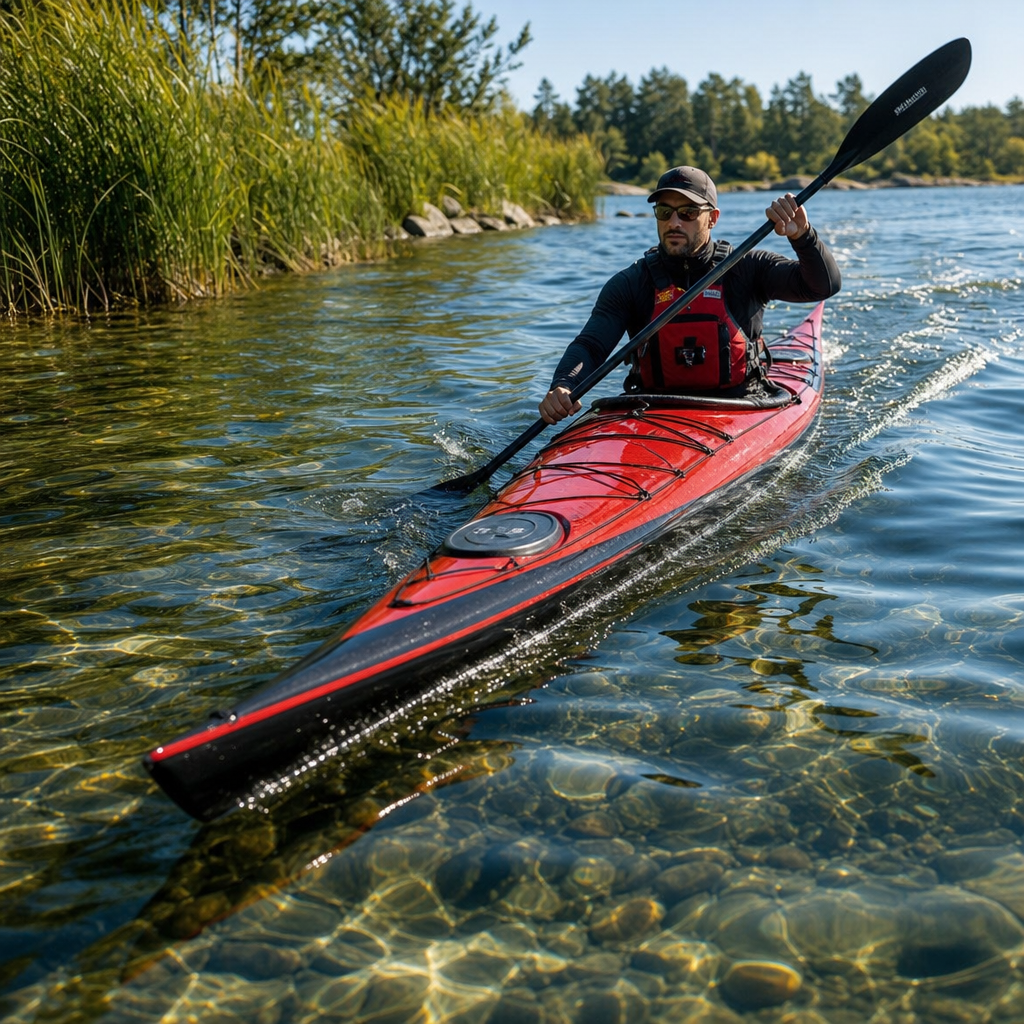
I’ve said it many times while kayak training or racing. “All of a sudden I feel like I am paddling through pudding.”
And then there have been times in kayak flat/open water races where I spot the waves at the surface of the water acting differently in different places and I headed to the longer waves because I knew the water was deeper there. (Shhhh! Don’t tell my competition this trick.)
Performance paddlers often notice that a kayak feels strangely sluggish in shallow water. The boat may sit normally, the paddle may not touch bottom, and conditions may appear calm—yet maintaining speed suddenly demands more effort. This phenomenon is commonly called shallow-water effect and is sometimes informally described as the ground effect of kayaking.
The effect is hydrodynamic rather than aerodynamic. As the distance between the hull and the bottom decreases, the water displaced by the kayak has less room to move. That restriction changes the pressure and wave patterns around the hull, increasing resistance and altering how the boat handles.
What happens beneath the hull?
A moving kayak must push water aside and allow it to flow back around and beneath the hull. In deep water, this disturbed flow can extend downward with relatively little interference. In shallow water, the bottom constrains it.
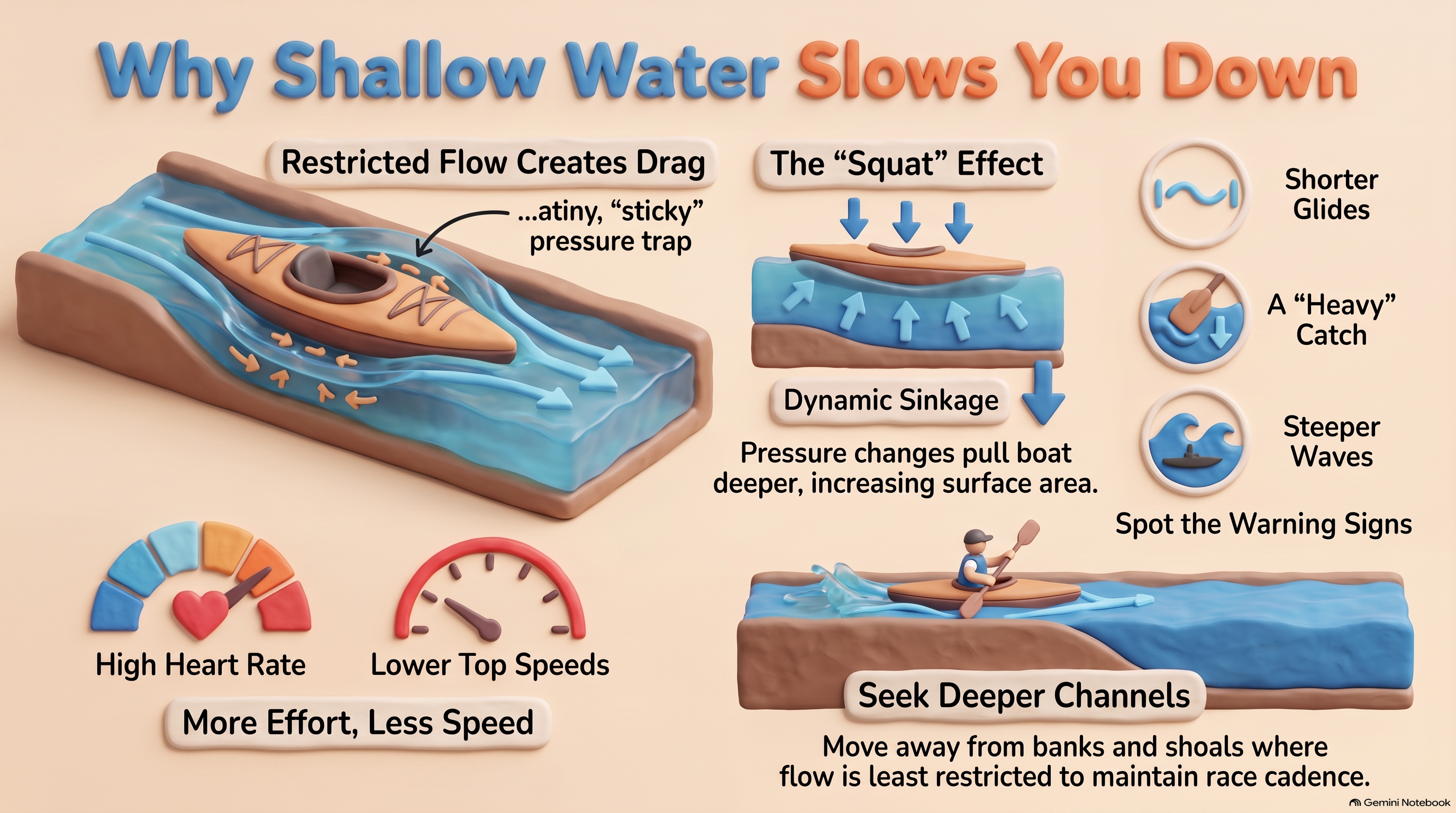
Water passing through the narrowing space beneath the kayak must accelerate. The associated pressure changes can make the hull settle lower in the water—a form of dynamic sinkage, often grouped with the marine phenomenon known as squat. Depending on hull shape and trim, the bow or stern may sink more than the other.
Several effects then combine:
Wave-making resistance increases.
The hull’s bow and stern wave systems interact more strongly with the bottom.
Pressure resistance rises.
Restricted flow produces a larger pressure difference between the front and rear portions of the hull.
Sinkage and trim can change.
More hull surface may become effectively engaged with the water, and the kayak’s attitude may shift.
The wake changes.
Waves may become steeper, more prominent, and increasingly directed sideways.
Steering may feel different. The boat can become less responsive or appear to wander because pressure and flow around the stern have changed.
The paddler experiences the combined result as a “sticky” or heavy sensation. I’ve heard fellow paddlers call it, “getting into the suck.”
Why high-performance kayaks reveal the effect
A recreational paddler moving slowly may notice shallow water only when the paddle begins striking bottom. A racing or fitness paddler can feel it much earlier.
Performance kayaks travel at speeds where wave-making resistance is an important part of total drag. Their narrow hulls and efficient deep-water flow also make changes in resistance conspicuous. Because trained paddlers produce relatively consistent power, even a modest hydrodynamic penalty may show up clearly as:
– Lower speed at the same effort
– Higher heart rate at the same pace
– Shorter glide between strokes
– A heavier catch
– Greater wash alongside the boat
– Difficulty holding race cadence without extra force
Longer, faster boats may therefore reveal shallow-water effects in depths that seem generous compared with the kayak’s actual draft.
Depth under the hull matters most
Water depth is usually measured from the surface of the water to the bottom of the hull, but the most relevant clearance is the distance between the bottom of the hull and the bed of the body of water.
There is no universal depth at which the effect begins. A commonly used rule of thumb in naval hydrodynamics is that bottom influence becomes increasingly relevant when depth is only a few times the vessel’s draft. For long, slender, fast craft, however, measurable performance effects may appear in greater relative depths because the wave system—not just the immediate flow beneath the hull—is being constrained.
The onset depends on:
– Kayak speed
– Hull length and shape
– Loaded draft
– Paddler and equipment mass
– Trim
– Bottom contour of the boat
– Channel width
– Water viscosity and temperature
– Current
– Nearby banks or other craft
Shallow water and narrow channels
Depth is not the only restriction. In a narrow canal or lane, the banks limit sideways flow just as the bottom limits downward flow. This is known as blockage or bank effect.
So the next time you feel like the water turned to pudding, it might just be shallow water effects.
You may also listen this this article in podcast form:
And, of course, the explainer video generated from this article:

