

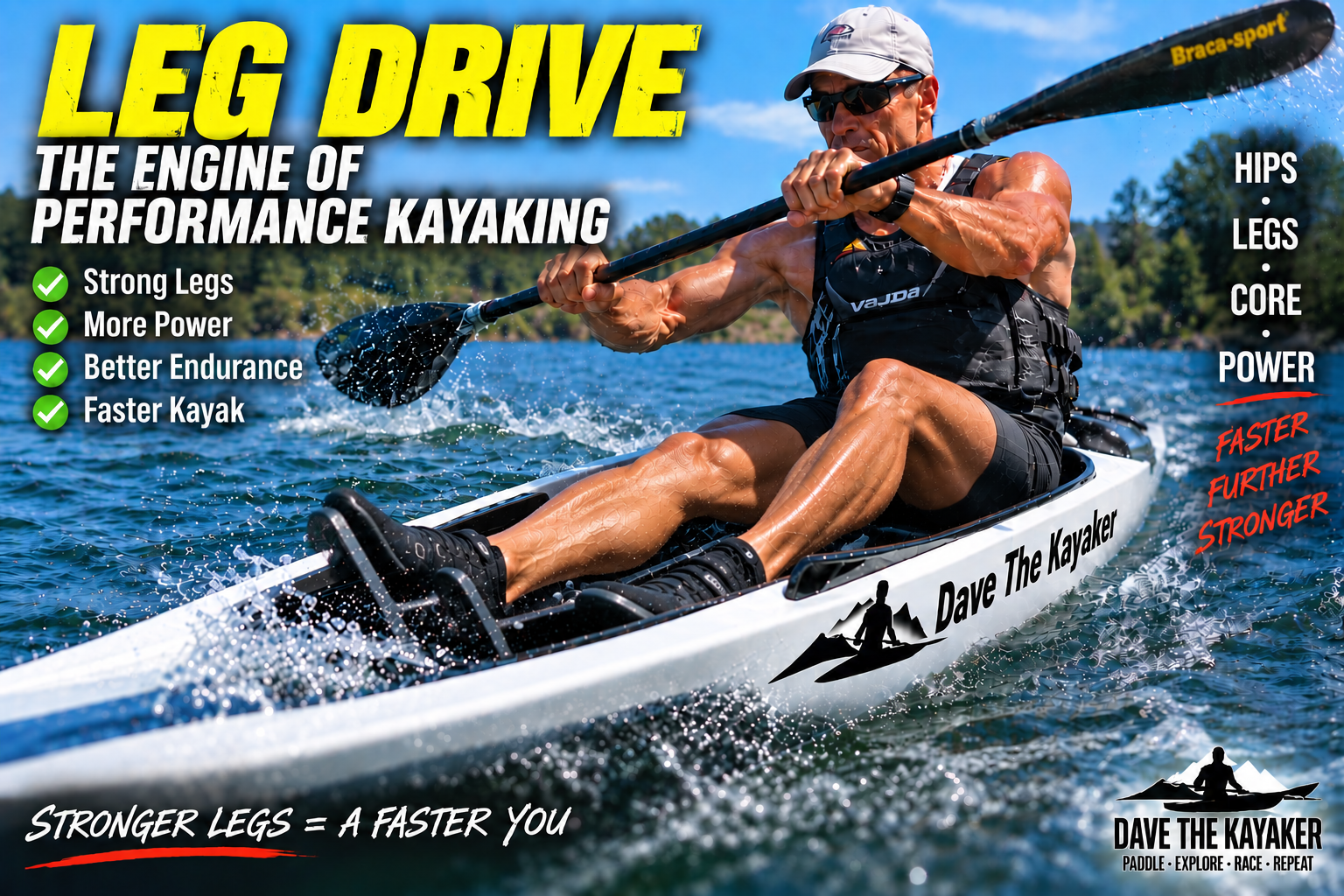
Many paddlers ask how advanced kayakers generate so much speed without appearing to paddle much harder than everyone else. In fact, they sometimes say the fastest paddlers look like they were doing the least work.
Some years ago after a race, I had a fellow paddler ask me how I went so fast because he observed he was “matching me stroke for stroke” yet he was still tailing off.
The short answer is efficiency.
But the entire answer is a little more involved.
Yes, a wing paddle for efficiency is essential, but there is still more to the story.
Online advice often focuses on paddle type or shape, boat design (especially by boat manufacturers,) stroke rate, or upper-body strength.
Yet one of the least explained aspects of performance kayaking is leg drive—the coordinated pressure applied through to the footrest during each stroke.
Leg drive does not propel the kayak by itself. Instead, it connects the lower body to the torso and paddle. As the right blade enters the water, the paddler presses through the right foot while rotating the torso to the right. This creates a stable chain of force from the paddle blade through the core and hips to the legs and then into the footrest. The pressure through the leg pushes the energy into forward propulsion of the boat while the lowering of that same-side hip allows for greater rotation. The opposite leg relaxes slightly, further allowing the pelvis to rotate.
And then it is all repeated on the left side.
And this sequence repeats over and over again throughout the entirely of the race or training session.
The movement should be rhythmic and proportional to the stroke. A useful cue is to imagine pushing the kayak past the paddle rather than pulling the paddle through the water.
Proper setup is essential. Footrests should be close enough for the knees to remain slightly bent, but not so close that hip rotation is restricted. In racing kayaks, a secure footplate and correctly adjusted seat position help transfer force most efficiently.
To practice, paddle at low intensity while focusing on alternating foot pressure. Watch the knees: each should move subtly forward and backward with torso rotation. Short intervals without gripping the paddle tightly can also reveal whether the legs and core are contributing.
Strong leg drive improves acceleration, stroke length, and endurance because it distributes work across the whole body. For many paddlers, the next speed gain will not come from paddling harder—it will come from learning to connect the feet, hips, torso, and paddle as one coordinated system.
This concept is the core of my LOL Paddling Methodology.
LOL in this context stands for: Legs. Obliques. Lats.
Afterall, all that energy expended and force created gets transferred into your kayak through your legs. Make sure they remain center stage in your paddling.


Dave, Great subject – often overlooked! I suggest to folks that they find a well filmed, long duration, world level sprint kayak video and just focus on the knees. Mike
LikeLiked by 1 person